Disclosure: Some of the links on this website are affiliate links. It's possible for me to receive a commission at no extra cost to you.
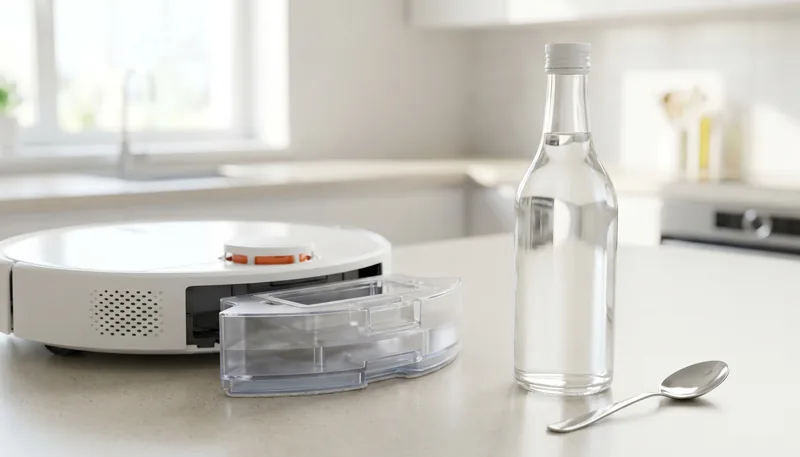
Quick answer: Do not put vinegar in a robot mop’s clean water tank or run it through a self-washing dock unless the manual or manufacturer explicitly allows it for your exact model. Roborock says to use only Roborock cleaning solution, and iRobot warns that water plus vinegar can cause corrosion and void warranty coverage. If you only want to clean a removable dirty water tank, hand-wash it according to the manual and rinse it thoroughly before reinstalling it.
“Can I put vinegar in my robot mop?” sounds simple, but there are two very different actions hiding inside the question:
- Pouring vinegar into the clean water tank, where pumps send it through the robot and dock.
- Using vinegar to hand-clean a removable dirty water reservoir, then rinsing it out.
The first can expose pumps, tubing, seals, filters, and floor finishes to an unapproved acid. The second keeps the cleaner in a plastic part you can rinse. That distinction matters more than how weak the vinegar mixture is.
Can I put vinegar in my robot mop?
Usually, no—not in the machine. Robot mops use small water passages and low-foaming systems. A household cleaner may attack materials the manufacturer has not tested, create residue, or foam when it mixes with another product already in the system.
The warranty-safe rule is straightforward:
- Use plain water if your manual specifies water only.
- Use the brand’s approved low-foaming solution if your model permits detergent.
- Use a dedicated solution cartridge only in the slot designed for it.
- Do not assume a mixture is safe because other owners say they have used it without a problem.
Can I put vinegar in my Roborock?
Roborock’s current support guidance says to use only Roborock cleaning solution in the water tank. Its support page also warns that other formulas may damage the tank or create bubbles that make mopping malfunction. When using Roborock solution, follow the dilution on the bottle and the manual for your model; Roborock’s support guidance lists 1:300 for models where the solution is mixed into the clean tank.
That means vinegar should not go in the clean water tank, detergent cartridge, or dock lines as a routine Roborock cleaner. Read what cleaning solution you can use in a Roborock for the model-safe options.
Robot mop vinegar rules by brand
| Brand | Safest rule |
|---|---|
| Roborock | Plain water or Roborock-approved solution; do not add vinegar to the machine |
| Roomba / iRobot | Use only an approved iRobot StayClean solution for the listed model or plain water; iRobot explicitly says not to use water plus vinegar |
| Dreame | Use water only or Dreame-branded detergent as specified by the model manual |
| Tineco | Use Tineco cleaning solution; third-party formulas can create excess foam |
| Eufy, Ecovacs, Narwal, Shark | Follow the exact model manual and use only the brand-approved low-foaming solution where permitted (Eufy, Ecovacs, Narwal, Shark) |
What if the dirty water tank already smells?
You do not need to send vinegar through the machine to fix a dirty reservoir:
- Remove and empty the dirty water tank as soon as the mopping job ends.
- Rinse it several times with clean, lukewarm water.
- Use the supplied brush or a bottle brush on the corners, float, lid, and seal.
- If the manual allows mild soap on the removable tank, use one drop and rinse until no suds remain.
- Air-dry the tank with its lid open before reinstalling it.
- Remove and rinse the dock’s washable tray or filter separately.
- Extend mop-pad drying time or remove the pads to air-dry if they are still damp.
Physical removal is the key. Vinegar can dissolve some mineral scale and neutralize some odors, but household vinegar is not a reliable disinfectant for every organism and should not substitute for scrubbing, rinsing, and drying.
If you want ongoing odor control without sending anything through the pump, two waste-side options do what people hope vinegar will: the original Roborock dirty-water deodorization module clips into compatible newer Roborock tanks, and silver-ion deodorizer pods can sit in a removable dirty reservoir on most brands — check the listing covers your tank and that the pod can’t reach the outlet. Best Roborock Dirty Water Tank Deodorizers compares the options.
For the complete routine, see Roborock Dirty Water Tank Smells Bad? 6 Fixes That Work.
Never mix vinegar with these products
- Bleach or chlorine cleaner: the combination can release toxic chlorine gas.
- Hydrogen peroxide: mixing them in one container can form irritating peracetic acid.
- A cleaner already in the dock: even two individually mild products can foam or react when mixed.
If you already poured an unapproved cleaner into the machine, stop the cycle and use the manufacturer’s support instructions for your model rather than adding another chemical to neutralize it.
Frequently Asked Questions
Can I put vinegar in my robot mop?
Not unless the manual or manufacturer explicitly approves it for your exact model. Use plain water or the approved low-foaming solution in the machine. Hand-clean a removable dirty water tank according to its manual, then rinse it completely.
Can I put vinegar in my Roborock?
Roborock's current guidance is to use only Roborock cleaning solution in the machine. Do not add vinegar to the clean water tank, solution cartridge, or dock lines. Empty, scrub, rinse, and dry the removable dirty water reservoir instead.
Will vinegar damage a robot vacuum?
It can. Acid may affect seals, tubing, metal parts, or floor finishes, and an unapproved liquid may affect warranty coverage. iRobot explicitly warns that water plus vinegar can cause corrosion, while Roborock specifies its own approved solution.
Can I clean a removable dirty water tank with vinegar?
Only if the manual for that tank permits it. Keep the tank out of the machine, use the weakest effective mix, never combine it with bleach or peroxide, and rinse until no vinegar remains. Plain water, a brush, and complete drying are the safest first steps.